

Watching water light up in complete darkness is one of the strangest and most beautiful things you can do on the Oaxacan coast. A short drive from Puerto Escondido, Manialtepec Lagoon is known for exactly that: bioluminescence, the ability of certain organisms to produce light through a chemical reaction.
When conditions are right and the water moves, small flashes appear in the dark. A hand, a boat, even a passing fish can make that light visible for a moment. But it is a natural phenomenon, not a scheduled show — its intensity changes from one night to the next.
Short answer
Manialtepec Lagoon, near Puerto Escondido, is one of the places on the Oaxacan coast where bioluminescence can be seen. The effect comes from microorganisms that emit light when movement in the water disturbs them. Dark nights make it easier to see, and natural conditions determine how strong it is on any given night.
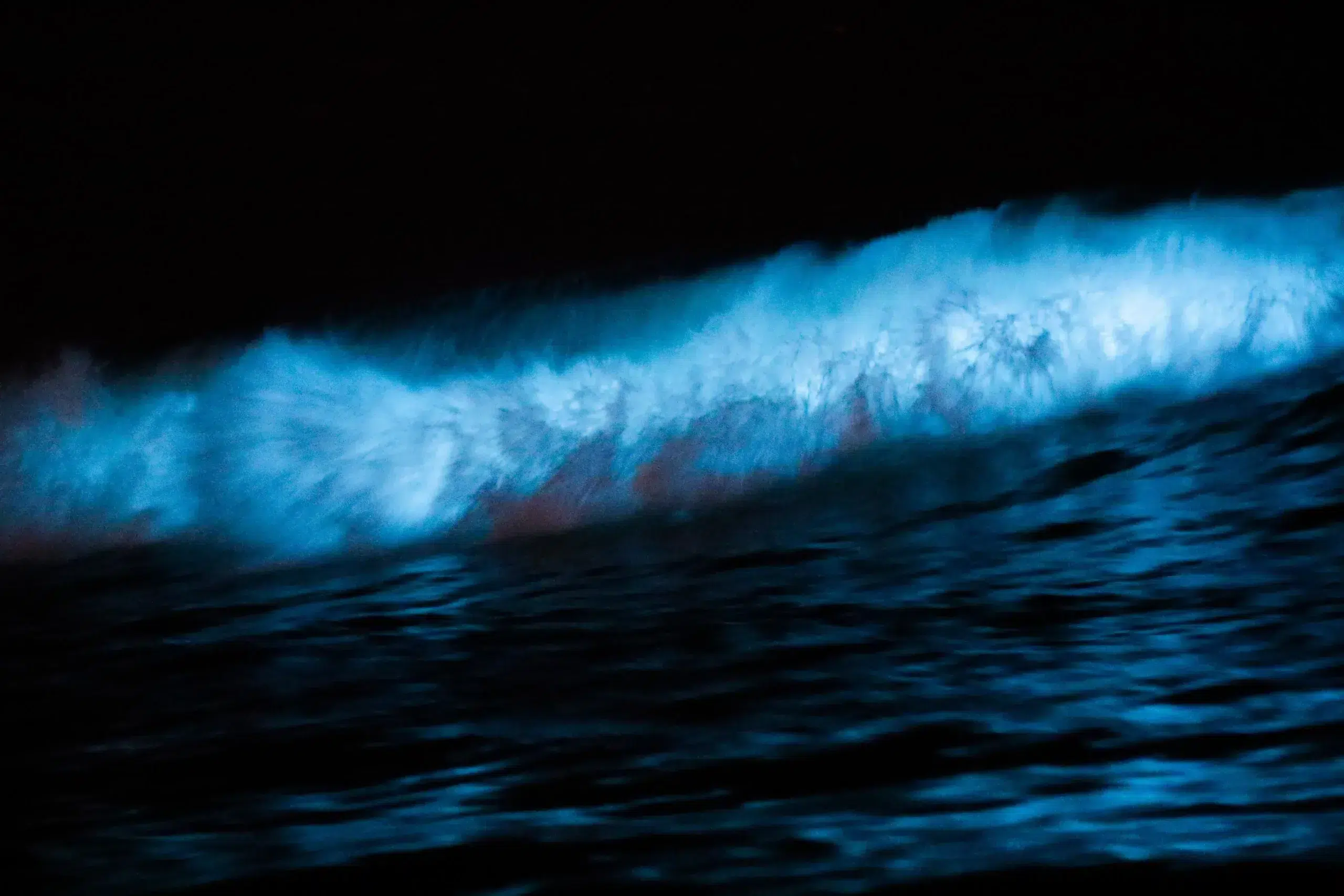
Where can you see bioluminescence near Puerto Escondido?
The best-known spot is Manialtepec Lagoon, a coastal ecosystem ringed by mangroves. It is close enough to Puerto Escondido that the trip works as an evening activity rather than a whole day out.
It is worth understanding that Manialtepec is much more than a place where the water glows. Different bodies of water meet here, and the mangroves make it one of the richest habitats on this coast — by day it is full of birds and wildlife. We cover that side of it in our guide to Manialtepec Lagoon.
What is bioluminescence, exactly?
Bioluminescence is light produced by a living organism through a chemical reaction. It occurs across many species and is especially common in marine environments.
At certain concentrations, microorganisms in the water give off brief flashes when something disturbs them mechanically: the water moves, a boat passes, a fish swims by, a hand goes in.
This matters more than it sounds. Plenty of photographs online suggest the whole lagoon stays lit up in electric blue. The real experience is dynamic — the water answers movement, and goes dark when everything is still.
Why does it happen at Manialtepec?
The lagoon has an unusual mix of conditions: fresh water, salt water and other inputs meet here, and the mangroves create a highly productive biological environment.
Among the organisms found in these waters are dinoflagellates, single-celled marine organisms associated with bioluminescent events. When there are enough of them and conditions cooperate, their response to movement produces the glow you see at night.
It is a biological process. There is no switch that guarantees the same intensity every night.
When is the best time of year?
Mexico’s National Institute of Anthropology and History (INAH) points to the rainy season, roughly May to November, as when the phenomenon is most commonly observed. Even within that window, nights vary a lot, so it is more honest to talk about favourable conditions than to promise a date.
That said, our team is on the lagoon year-round and sees activity outside that window too. When a phenomenon is most often documented and whether it is visible on one particular night are two different questions. If your trip falls outside the peak period, the sensible move is to ask about recent conditions before booking.
Does the moon affect bioluminescence?
Yes, but not in the way people usually assume. The moon does not switch the organisms on or off. What changes is how much ambient light your eyes have to compete with.
The darker the surroundings, the greater the contrast between the dark and the flashes in the water. That is why nights close to the new moon tend to offer the best viewing conditions. Under a full moon there can still be bioluminescence, but the extra ambient light makes it look weaker.
Cloud cover, the hour and the moon’s position all change the experience too. It is not as simple as “full moon, impossible” or “new moon, guaranteed”.
What does it actually look like?
This is probably the most important question to settle before you book. The photos circulating online tend to show intense blues and entire surfaces glowing. You should not expect precisely that.
In natural conditions the effect reads as points or flashes that appear as you move the water. With more movement, a luminous trail can become visible for a few seconds. Intensity shifts with conditions — and that is part of the point. You are not looking at a light installation. You are watching living organisms respond.

Why is it so hard to photograph?
Your eyes and a camera do not handle light the same way. Bioluminescence can be perfectly visible to a person and still be almost impossible to capture on a phone.
Photographing anything in this little light usually needs long exposures, a stable camera and specific settings. A lit screen or any artificial light also ruins your dark adaptation for several minutes — which is exactly what you need in order to see well.
Experience it with your own eyes first. Do not judge the night by what your phone managed to record.
What the night trip is like
The evening starts with hotel pickup in the late afternoon and continues by boat towards the lagoon as the light fades. The crossing is when your guide explains what you are about to see, how the phenomenon works, and the safety instructions.
Length
Around 3 hours in total
Departure
Late afternoon, pickup included
Group
Small, to keep the lagoon undisturbed
Swimming
Optional, life jackets available
Do not confuse the time spent watching the bioluminescence with the length of the whole outing. Exact departure times, pickup arrangements and current conditions are on the bioluminescence tour in Puerto Escondido page, which is where to check before booking.
Can you swim in it?
Conditions and protocols for entering the water change, so whether swimming happens is decided by the state of the lagoon that night and your guide’s instructions.
What we never recommend is going into the water on your own, or anywhere in Manialtepec. It is a natural ecosystem, and local guidance exists for good reasons.
Is Manialtepec Lagoon safe?
Manialtepec is a wild ecosystem, not a swimming pool or a water park. It is home to many species and should be visited following the guidance of people who know it. An organised trip means set routes and procedures for the activity.
We do not recommend exploring unfamiliar parts of the lagoon on your own at night, or entering the water outside the places set out for the experience.
Are there crocodiles in the lagoon?
Yes. Crocodiles are part of the wildlife at Manialtepec. That is not a reason to be afraid of visiting, but it does explain why a wild ecosystem is not treated like an ordinary swimming spot. Follow your guide’s instructions and avoid entering the water on your own anywhere that has not been indicated.
Bioluminescence and responsible tourism
Watching bioluminescence means entering a living ecosystem at one of its most delicate moments. Keeping your impact low comes down to a few simple things:
- Follow your guide’s instructions
- Put nothing in the water
- Do not touch or catch wildlife
- Keep artificial light to a minimum
- Leave nothing behind in the lagoon
- Respect mangroves and sensitive areas
- Avoid disturbing animals unnecessarily
- Ask which repellent is safe before swimming
Understanding why the phenomenon happens also makes it obvious why the ecosystem behind it is worth protecting.
What to bring
Travel light and check in advance what the trip includes: comfortable clothes, suitable footwear, a change of clothes or a towel if swimming is on the cards that night, something warm for the ride back, and only the personal items you actually need. Before using repellent or sunscreen if you plan to swim, check with the operator so nothing unnecessary goes into the water.
Is it a good activity with children?
It can be wonderful for families, but it depends on the child’s age, conditions that night and the format of the trip. Keep in mind that it happens after dark, on a natural lagoon, with very little light. With young children, check the minimum age and current conditions before booking.
Manialtepec or Chacahua?
Both are associated with bioluminescence, but they are not the same kind of outing. If you are staying in Puerto Escondido and want to add an evening experience, Manialtepec wins on proximity and on how easily it fits alongside daytime activities.
The Chacahua Lagoons deserve to be treated as a destination in their own right rather than simply somewhere to look for a glow. Which one suits you depends on your itinerary, your time, and above all on conditions during your visit.
What else there is to do at Manialtepec
A common mistake is to associate Manialtepec only with bioluminescence. By day the lagoon is a completely different experience: the mangroves are habitat for a long list of species and open up the place through nature and birdwatching.
We cover that in our Manialtepec Lagoon guide — the ecosystem, the wildlife, the mangroves and what can be done during daylight. And if you are after another wildlife trip after dark, the baby sea turtle release in Puerto Escondido is the other sunset outing we tend to recommend.
Is it worth it?
If you are drawn to nature and natural phenomena, it can be one of the most memorable evenings of a trip to Puerto Escondido. But go with the right expectations: it is not a manufactured show, no two nights are identical, no intensity can be guaranteed, and your phone probably will not record what your eyes see.
That is exactly what makes it different. You are heading into a mangrove ecosystem after dark to watch a biological process that depends on the conditions of that particular night.
See it with Eco Adventures
Our approach is not to reach the lagoon, take a photo and head home. We want you to understand the place, understand the phenomenon, and enjoy the evening while respecting the ecosystem that makes it possible. If you have questions about visibility, the moon or the state of the lagoon on your dates, ask us before you book.
Frequently asked questions about bioluminescence in Puerto Escondido
Where is there bioluminescence near Puerto Escondido?
Manialtepec Lagoon is the best-known place near Puerto Escondido to see this natural phenomenon.
When is the best time to see it?
Conditions vary. INAH highlights the rainy season, roughly May to November. It is worth checking recent conditions before booking.
Is a new moon better?
Darker nights make viewing easier because there is less ambient light, which improves the contrast of the flashes. That alone does not determine whether the organisms are present.
Is there bioluminescence during a full moon?
There can be, but moonlight reduces the contrast and makes it harder to see.
Is it guaranteed?
No. It is a natural phenomenon and its intensity changes with environmental conditions.
Can I photograph it with my phone?
You can try, but there is very little light to work with, and a photograph does not necessarily represent what the human eye perceives.
Can I visit Manialtepec on my own at night?
For a night activity in a natural ecosystem we recommend an organised trip and following the guidance of people who know the lagoon.
Is Manialtepec only worth it for the bioluminescence?
No. The lagoon is also an important mangrove ecosystem and can be visited by day for its landscape, wildlife and birds.
Last reviewed: 18 September 2026. Institutional sources: INAH, for information on Manialtepec Lagoon, its mangroves and bioluminescence, and NOAA Ocean Exploration for the scientific definition of the phenomenon. Observations on recent conditions and logistics come from the guide team at Eco Adventures Puerto Escondido.

